
Headaches
Headaches are a form of pain (link to pain and dysfunction article word PAIN) that vary in character and nature as not all headaches are the same. They can range from occasional to frequent, mild to debilitating and lead to symptoms such as dizziness, nausea and even weakness. The character of a headache relates to location, presentation of sensation and intensity of pain. Whereas the nature of the headache relates to the cause, defining it either as a primary or secondary headache.
Classification of headaches
Headaches diagnostically speaking, are classified into 2 main categories:
Primary headaches are defined as nonstructural as they are pathophysiologic in nature, meaning there is no identifiable underlying disease as the headache itself is the primary cause.
Secondary headaches are defined as structural when they are pathological in nature, meaning there is an identifiable underlying disease, infection/sickness, physical abnormality, injury, or damage. Or there can be a secondary pathophysiological disruption, meaning the pathophysiology of the headache is a symptom, rather than a cause of the headache directly.
History taking and self observation
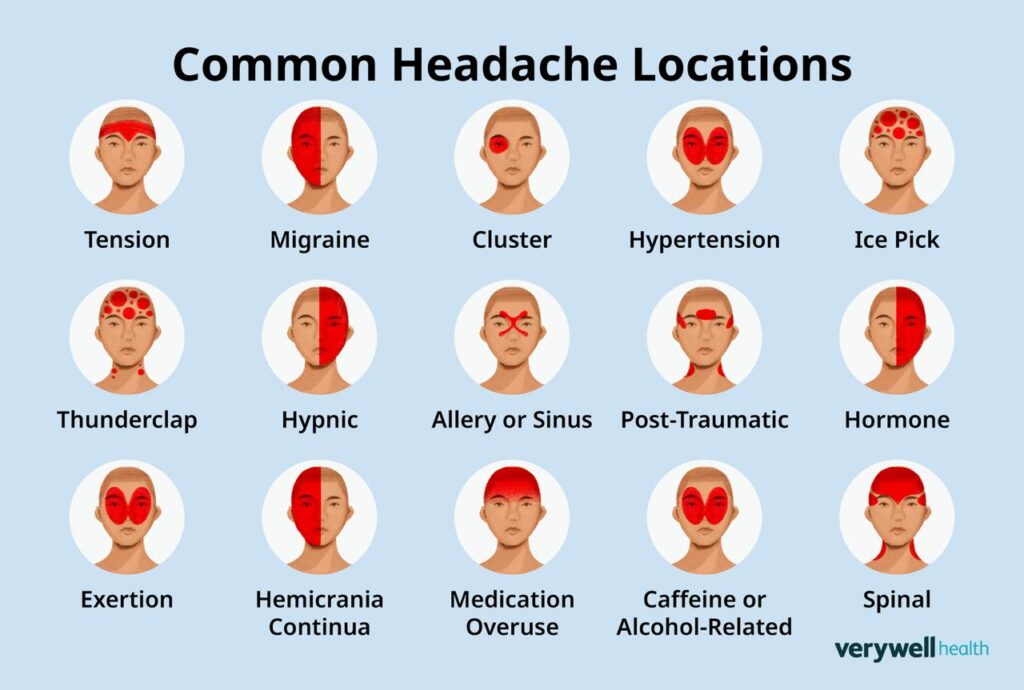
Location of headache is of importance when taking a headache related history. We have placed these as pictures.
Other factors of consideration other than the nature and character of pain, include time of day experienced, duration, onset (when did it start), triggering or aggravating factors, relieving factor, associated signs and symptoms and your family’s history.
Red flag considerations related to nature and character of pain generally indicate a more sinister type headaches, these can relate to severe pathological causes like tumors, infection such as meningitis, causes of raised inter cranial pressure, bleeding on the brain and may lead to death especially if picked up in the later stages, where time without diagnosis has led to progression and complications. Majority of headaches can only be managed not cured and this is where the potential to slow or stop progression/complications needs to take place over time. Therefore prevention is better than cure and this is why headache management is of importance.
These sinister red flag type headaches are generally sudden, intense, severe unrelenting headaches and are often accompanied with symptoms and/or signs from 1 or more of the 11 systems of the body (Integumentary, skeletal, muscular, nervous, endocrine, cardiovascular, lymphatic, respiratory, digestive, urinary and reproductive system).Symptoms may include fever, stiff neck, confusion, or weakness, visual disturbances, change in location and nature of pain, weight loss (10kgs over 3 months) and/or starts after a head injury/trauma. It’s often described as the “worst headache of the persons life” and starts from the age of 50 plus. There have been cases reported where individuals in their 30s have had strokes, cancer etc so it can be at any age.
Lifestyle
General factors that may be of consideration are posture, eye strain headache from too much screen time, water (Dehydration, over hydration) and food intake (Post prandial headaches including food sensitivities and allergies, hunger headaches, Vitamin and mineral deficiencies or toxicities, reactive hypoglycemia etc), stress and emotional management, sleep patterns/sleep quality, hormonal influences, diet triggers (Caffeine, chocolate, alcohol, red meat, highly processed sugar, dairy etc), physical overexertion (running, jumping, weightlifting, sexual intercourse, bouts of coughing or sneezing), repetitive strain at work, climate and environment (Aircon in a controlled environment, Altitude or mountain sickness), stimulus such as motion (motion sickness),cold (brain freeze), lights/sounds, substance abuse and withdrawals like coffee, nicotine, alcohol etc and medication overuse or withdrawal.
As these relate to many different headaches and it is possible to experience more than one type of headache at the same time.
If you address these factors, you begin to start preventing or managing your headaches rather than being reactive and only treating or addressing them once they occur. Often at the point of occurrence the headaches pathophysiologic cycle needs professional help to be broken, reset or restored. Treatment over time will help manage any potential progression and/or complications too. This sometimes means you won’t always get instant relief at your first consultation. This is because the cycle needs time with treatment to be broken. This is more dependent on the nature or type of headache experienced, as some headaches are more responsive to chiropractic treatment than others. One must consider everyone’s case uniquely even if it be the same diagnostic headache. For example, not all migraines are the same, a trained professional such as a Chiropractor can help aid with these individual factors according to the presenting case. Treatment is often accompanied by these unique self care options for optimum results.
Often when a headache is described as a migraine, it’s because of the intensity of the headache experienced, yet when diagnosed it is not a true migraine, rather a different type of headache and can often be managed more effectively with a true diagnosis.
A vast majority of trigger and dietary factors relate to migraine headaches which is actually a diagnosis by exclusion, this is why it is a primary headache, as there is no identifiable underlying cause only a combination of factors linked to the headache.
There are over 150 headaches in is existence, in this article we will cover some of the different primary and secondary headaches, with the main focus on breaking down the headache’s chiropractors see more often.
The 3 headaches that account for 90% of all headaches experienced are:
1 Tension, 2 migraine and 3 rebound headaches. These statistics can change over time and can vary according to specific demographics.
The most common headaches seen by chiropractors are:
1 Tension (Primary), 2 Migraine (Primary), 3 Cervicogenic (Secondary), 4 TMJ or jaw (Secondary) and 5 post concussive syndrome headaches (Secondary).
Migraine being the headaches of the more difficult ones to treat as it is multifactorial, meaning there are many factors to consider especially as there is no cure.
Tension-type Headache:
Presentation: Tight pressing band around the head with or without frontal/occipital
association. Occurs in females more than males.
Causes: Muscular and psychological factors such as stress, anxiety, depression,
poor posture, and social problems.
Migraine (can occur with or without aura):
Presentation: Intense, throbbing, one-sided pain often accompanied by nausea. Can
be Unilateral or bilateral, with aura (20%) or without aura (80%). The aura is usually neurologic including symptoms of nausea, vomiting, dizziness, tinnitus, Scotoma’s (blind spots), photophobia or visual scintillations (flashing lights), fortification (zig zags). Its more common for females (3:1) to experience migraines than males.
Causes: The proposed pathophysiology is vasodilation caused by the neurogenic peptides such as serotonin and dopamine. More than 80% of cases are diagnosed before the age of 30. Family history, medications (vasodilators, birth control), fatigue and emotional stress, specific foods, alcohol, and exertion.
Cervicogenic Headache (Referred pain in the head caused by a neck problem):
Presentation: Pain localised to the neck, occiput, forehead, orbital region, temples,
and the vertex of the ears. Potential sensory abnormalities and a similar band sensation to a tension headache. Generally speaking, this is a non-throbbing or lancinating (sudden stabbing, sharp or electric) pain. generally, starts in the neck and subsequently moves to the areas of referred pain. Can be accompanied by symptoms such as nausea, photophobia, dizziness and ipsilateral (one sided) blurred vision, difficulty swallowing, earache, or tinnitus (Ringing in the ears).
Causes: Vertebral column, cervical muscles, cervical roots and vertebral/ carotid arteries, occupational hazards.
TMJ Headache:
Presentation: poorly localised jaw pain (80%), pain while chewing, limitation in mouth opening (3 knuckle standard), and popping, clicking, or grinding noises in the air or jaw. These lead to earache (30%) and headaches. It is often associated with bruxism, clenching, dizziness (20%) and a psychiatric history (30%). 4:1 Ratio for females more common than males.
Causes: Divided into 3 categories, myofascial pain dysfunction syndrome (most common) which generally relates to the muscles of mastication (Muscles of the jaw for chewing etc). Internal derangement where there is an abnormal relationship of the articular disc to the mandibular condyle, fossa or articular eminence. degenerative joint disease which is organic degeneration of articular surfaces.
Post concussion headaches:
Presentation: post concussive syndrome is regarded as a minor head injury (MHI), a bruising of the brain if one can say. Apart from the headache, symptoms can include dizziness, fatigue, irritability, impaired memory and concentration, insomnia, lowered tolerance to noise and light. concussion is one step away from experiencing a bleed or clot. Bleeds and clots are generally Epidural, subdural or subarachnoid depending on location, severity, repetitive knocks etc. At this point the condition can be life threatening
Causes: Trauma, although this is where Sporting vs nonsporting (MVA i.e. motor vehicle accident) mechanisms of injury come into play, in consideration of the severity of symptoms present. This is to make sure there is no bleeds mentioned as these are more serious and can be life threatening if not picked up.
When to see a CHIROPRACTOR
When taking your headache into consideration, these are the questions one should ask themselves:
1 has the headache been diagnosed by a professional?
This would be your first step; chiropractors are trained diagnostic professionals. Once a diagnosis has been made, the next question can be addressed.
2 What is my journey to recovery, restoration or management?
As chiropractors we are alternative health care providers, so we are not on the mainstream medical referral list. If you have never been referred to a chiropractor, give yourself the referral you deserve and need. Chiropractors offer an effective nonsurgical and medication alternative to headaches, back and neck pain, jaw pain, sciatica and nerve pain, joint and muscle pain, spinal conditions, geriatric and paediatric conditions, sports injuries and rehabilitation. Sometimes for optimum management and results, one will need to see a chiropractor, be on medication and implement self-management protocols into their lifestyle (The Multidisciplinary approach). If all else fails and surgery is a realistic choice, then surgery will still be available. Initially in the journey, if surgery can be prevented, we would have established this and there will no longer be a need for surgery till perhaps a later stage in life. Especially if surgery was initially unnecessary, as majority of people are not well informed about chiropractors and their treatment options.
Trueback Chiropractic and treatment
At Trueback we first look at diagnosing the headache, chiropractors are able to refer for x-ray, ultrasound and for blood tests in order to investigate further. If an MRI is needed, we partner with a specialist and move forward accordingly. Once the diagnosis has been established, we can begin to address the unique factors to every individual’s case.
Depending on what the type of headache you experience, you are looking at 2-4 treatments for recovery and restoration. If restoration is not a reality we move into the management phase. In terms of relief this can range from 20%-100% relief from the first consultation. The general rule is that at 80% relief the body will either restore or need to be managed chronically (6 months or longer than the expected natural healing time frame in consideration of severity, complications etc). Sometimes people will experience relief for years and others only for months. One has to understand that the body is built up of working parts (The 11 systems mentioned) that wear and tear just as a car would especially with repetition, work, age, injury etc. Given the fact that majority of headaches are managed and not cured, it is of interest for everyone to take care of their body and its 11 systems with all its working parts.
What this might look like is you seeing a Chiropractor every 1-6 months for example in order to prevent and manage your headaches. This generally ends up cheaper than taking 2 pain pills every day for that same period of time and doesnt cause strain on the kidneys, liver, stomach/intestines etc. At Trueback our goal is always to see you less often and to see you get better as you grow with Chiropractic philosophy and lifestyle. In general, it’s recommended to see your chiropractor 1-2 times a year if you do not really experience any issues (Every six months or once a year). Yet if work, life, sport etc demand a lot from you and your body personally, you might need to see the chiropractor once a month or once every 2-3 months. Some athletes will see a chiropractor once a week, every week for a season of 1-3 months for example as the demands on their body are generally extreme and over extended periods of time.
If you translate this into mileage, some people will reach 15000km way before others because they travel more. Same principle applies with athletes; they reach their mileage before the general population. Personally, I see my chiropractor once a month, I call it my 15000km service as I train like an athlete, travel 500km a week and being a chiropractor is physically demanding profession.
Here is a list of some primary and secondary headaches with their location, presentation and cause (Nature and Character), some secondary headaches can be classified as structural or nonstructural depending on their cause. One example is TMJ as it can have structural and nonstructural causes. Structural being pathologic and nonstructural being pathophysiologic generally speaking related to the cause. Another example is primary and secondary cough headaches.
Common headache locations
Many headaches have similar sensation distributions and can feel differently to people.

Primary:
Tension-type Headache: (See above)
Migraine (with or without aura): (See above)
Cluster Headache (Histamine headache): Rare, extremely severe, burning/piercing pain, usually around one eye and the temple. Often accompanied by lacrimation (84-91%), nasal stuffiness (48-75%), nausea (40%), perspiration (26%), conjunctival injection (swollen red eye), mild Horner syndrome, scalp/face tenderness and jaw/tooth pain etc. Caused by dysfunction in the hypothalamus, hypothesised to trigger chemicals such as histamine or serotonin that cause inflammation of the trigeminal nerve. The two existing forms are episodic (6 month or longer break after episodes) or chronic (less than 1 week break for the entire year).
Ice Pick Headache (Primary Stabbing): Short, sharp stabs of pain, often lasting only a few seconds. Causes are things such as fatigue, stress, rapid movement, bright lights and alcohol.
Thunderclap Headache: A very sudden, severe, and rapid-onset headache. The cause is idiopathic, meaning spontaneous occurrence without a known cause. This headache is diagnosed only once all secondary headaches have been ruled out, these mainly relate to the causes of secondary pathological or structural bleeds.
Hemicrania Continua: A continuous, one-sided headache that responds to specific medication. The cause for this is also idiopathic, rarely in some cases it can be defined as a secondary headache when an underlying cause has been identified.
New Daily Persistent Headache (NDPH): A headache that feels persistent and daily right from its onset. This headache is generally primary but can be diagnosed as secondary as it is often lined to viral infections and stress.
Hypnic Headache: “Alarm clock” headache that wakes people from sleep. Predominately idiopathic but hypothesised to be disruptions in the hypothalamus, reduced melatonin production and miss firing during REM (R1 ie dreaming sleep) and non-REM (N1-3 of which N3 is deep sleep) sleep.
Primary Exertional Headache: Generally characterised by bilateral or a general throbbing or pulsing sensation, commonly around the occiput and temples. Triggered by physical activity, running, or weightlifting.
Primary Cough Headache: Valsalva manoeuvres i.e. Triggered by sneezing, coughing, or straining. Generally bilateral affecting the front or top of the head and is described as sharp, stabbing or bursting. This can also be a secondary headache for example if there is an underlying condition such as Chiari malformation, brain
tumours or emphysema and COPD.
Primary Sex Headache: Occurs during sexual activity, particularly around orgasm. Generally described as a bilateral dull pain in the occipital and neck region, sometimes ending with a sudden thunderclap type headache sensation as if you have taken a blow to the head.
Nummular Headache (Coin shape headache): Pain that occurs in a small, distinct circular area of the head. The exact cause is unknown, but it is hypothesised to originate in the peripheral nerves of the scalp or dysfunction of the epicrania tissues.
Secondary headaches:
Pathophysiological causes of secondary headaches
This was briefly touched on in the section “Lifestyle” where the focus was based more on the factors, here we will dive deeper into the specific headaches themselves, with their location, presentation, and causes:
Medication-overuse Headache (Rebound headache): Caused by overusing pain medications.
Sinus Headache: described as a deep constant pain or pressure around the sinuses (forehead, cheekbones and bridge of the nose). Caused by inflammation/infection of the sinuses.
Secondary Cough Headache: Valsalva maneuvers i.e. Triggered by sneezing, coughing, or straining. Generally bilateral affecting the front or top of the head and is described as sharp, stabbing or bursting. There is an underlying pathological cause to the secondary cough, if in the brain generally a Chiari malformation, otherwise it
can be caused by a brain tumour or if in the respiratory system (lungs mainly), things such as emphysema and COPD.
Hangover Headache: Bilateral throbbing or pulsating pain, often felt across forehead and temples. Caused by excessive alcohol consumption.
Caffeine Withdrawal Headache: bilateral throbbing or pulsating pain, usually starts behind the eyes before moving to the front of the head. Occurs when cutting back on caffeine.
Menstrual/Hormonal Headache: Usually a unilateral throbbing or pulsating pain and is common for the pain to shift side or sometimes be bilateral. Triggered by hormonal fluctuations (e.g., in menstruation, pregnancy, or menopause).
Hypertension Headache: throbbing or pulsating pain on both side of the head, sometimes occipital. Resulting from extremely high blood pressure.
Spinal Headache (Low-pressure): typically, bilateral or frontal, occipital and can radiate into the neck and shoulders. Its hallmark is positional severity where the pain is aggravated by sitting or standing and relieved by lying down. Occurs due to low cerebrospinal fluid pressure, often after a lumbar puncture.
Ice Cream Headache (Cold stimulus/Brain Freeze): usually in the forehead and temples and is Caused by cold food or beverages.
Dental Headache: Triggered by tooth infections or dental issues.
Eye Strain Headache: Generally, a dull achy pain directly behind, around or above the eyes, Caused by uncorrected vision or intense screen usage. Altitude/Mountain Sickness Headache: often described as a hangover type headache, bilateral often in the frontal and temporal regions. Intensifies with coughing and sneezing. Caused by low oxygen at high altitudes.
Dehydration Headache: often described as a dull, constant throbbing ache that intensifies with movement and improves upon rehydration. Caused by lack of adequate fluids. While dehydration might be one symptom of a hangover headache, dehydration headaches can happen in the presence and absence of alcohol.
Post-COVID Headache: Often the frontal and temporal regions and is associated with photophobia, phono-phobia, nausea and may last months. Often stemming from lingering neuroinflammation, activation of the trigeminovascular system or vascular changes. Persistent headaches following a COVID-19 infection.
TMJ Headache: (See above)
Cervicogenic Headache: (See above)
Cluster headache: Strictly unilateral, often described as a deep stabbing or burning sensation. Located deep behind the eye, temple or forehead. Last 15 mins for up to three hours and is often accompanied by autonomic symptoms such as runny nose, teary eye or a drooping eyelid on the effected side. Primary nonstructural
Trigeminal neuralgia: Sudden intense electric shocks or stabbing pain of the face and jaw. Multiple causes, primarily a blood vessel compressing the trigeminal nerve, tumors, multiple sclerosis, nerve damage from trauma or surgery and infections such as shingles (Herpes zoster virus). Therefore, pathologic and pathophysiological
causes.
Pathological causes of secondary headaches
Space occupying lesion (sol): Often described as a progressive, persistent and severe. Either dull, bursting, throbbing or an intense pressure like pain. These tend to be worse when lying down or in the morning. These general present with signs and symptoms of raised inter-cranial pressure. Whilst often rare, pain is caused due to pressure. Causes include tumour, abscess, cyst. These are considered life threatening and emergency conditions especially if there are signs of raised inter-cranial pressure.
Post concussive headache: Can range anywhere from a normal headache to a tension, migraine or cervicogenic headache. This can be defined as bruising of the brain, if misdiagnosed, this could potentially be life threatening as it presents similar to hematoms and haemorrhages of the brain.These are usually caused by trauma, from motor vehicle accidents, blunt force trauma and child/elder abuse.
Hematomas and haemorrhages:
A haemorrhage is an active on going bleed and a hematoma is an accumulation, pooling or clot from the original bleed.
These are named according to location and pathophysiology:
Epidural haemorrhage and hematoma
Subdural haemorrhage and hematoma
Subarachnoid haemorrhage and hematoma
Inter-cerebral or interparochial haemorrhage and hematoma
Inflammatory
Meningitis: Generally, affects the entire head rather than a specific location and is described as intense or severe throbbing. Is often accompanied by tell tail signs and symtoms such as high fever, stiff neck, photophobia and bi lateral leg pain. caused by an infection, more commonly viral and bacterial, sometimes fungal. Bacterial meningitis is considered a medical emergency as it can be more life threatening, even though less common than viral meningitis.
Encephalitis: often a general headache that incorporates the entire head. Inflammation of the brain parenchyma, generally caused by viral infections or auto immune disease. Frequently accompanied by fever, altered consciousness and focal neurologic defects
Vascular
Giant Cell Arteritis (Temporal Arteritis i.e TA): Typically located in the temples around the artery or in the forehead. Described often as throbbing with scalp tenderness and jaw claudication or as an ache or cramping pain if in the lower extremity.
Claudication can be thought of as blockage to flow, it can either be neurological or vascular, with TA this would be defined as vascular claudication. It’s caused by Inflammation of the arteries in the temple, common in people over 50. The trigger is unknown yet there is a risk linked to family history and genetics, smoking and existing polymyalgia rheumatica.
Glaucoma: Nonspecific increased ocular pressure with decreased visual acuity (Sharpness, clarity and detail). Acute angle-closure (AACG) is a medical emergency. Commonly periorbital pain that’s ipsilateral, causing a boring ache and pain on eye movement. Often accompanied by visual defects such as blurred vision, seeing halos around objects. Causes include shallow anterior chamber, anteriorly situated lens, shorter axial eye length, thin and floppy iris, and a narrow angle lead. Precipitating factors include medication and drugs, dim light and rapid correction of hyperglycaemia.
Strokes
Important considerations are acute neurologic deficits, altered level of consciousness, generally if the left side of the brain is affected the right side of the body will be affected and visa vera.
Ischemic stroke: Generally, less sudden and severe than hemorrhagic strokes. They are caused by an embolism (clot breaks off and travels, causing distant blockage) or thrombosis (formation of a clot causing local blockage). Depending on where the blockage is, will depict exactly how the stroke manifests and where the headache is more likely to be felt. 1 anterior cerebral artery, 2 middle cerebral artery, 3 posterior cerebral artery and 4 vertebrobasilar artery. The headache is described as sudden, severe and the worst headache of the individual’s life. The tell tail signs of this condition present more as speech, weakness, paralysis, loss of consciousness etc. One differential diagnosis for a stroke is epilepsy. Risk factors include age, hypertension, smoking, heart disease, hypercholesterolemia (high LDL i.e. bad cholesterol), oral contraceptives, diseases associated with increased blood viscosity, previous cerebrovascular disease and TIAs. TIA’s (Transient ischemic attack) are generally and indicator of stroke in the future, they can be classified as a “mini
stroke” as there is a temporary blockage of blood flow. Usually, last less than an hour with no permanent damage. Cerebral venous thrombosis is another rare cause of stroke, this occurs when blood clots form in the brains venous sinuses (Specialised space that drains venous blood and CSF ie Cerebrospinal fluid flow accounts 3% of all strokes) rather than the arteries (which account 87% of all strokes) as in a ischemic stroke. Its linked to factors such as blood clotting disorders, pregnancy, oral contraceptives, severe infection, dehydration etc.
Hemorrhagic stroke: Often severe bleeding of the brain into the brain parenchyma (Functional or working tissue of the brain). Sudden and severe with seizures (28%) and Hypertension i.e. high blood pressure (60%). Risk factors include age, cerebral amyloidosis, coagulopathies, thrombolytic therapy, arteriovenous malformation, cocaine/alcohol abuse and other sympathomimetic substances, intracranial aneurysms, vasculitis, sol, history of prior strokes. These factors cause long term damage or structural abnormalities of the blood vessels.
Epileptic and seizure headaches: Majority of the time the headache comes post seizure yet can also present before or during. Depending on what type of seizure experienced will depict where and how the headache presents. It can be frontotemporal, ipsilateral or bilateral. Seizures are generally broken down into 3 categories: focal (one area), generalized (multiple areas) or unknown onset as there are over 40 types. Epilepsy is a form of seizure, the difference is a seizure can be caused by multiple reasons such as infection, low blood sugar whereas epilepsy is caused by abnormal brain activity. This is usually experienced as a sudden surge of electrical brain activity. Epilepsy is a chronic while in general seizures are usually temporary and caused by another underlying condition.
Disclaimer:
This article does not intend to replace professional medical advice,
diagnosis, or treatment. Rather to inform and educate the population about
headaches. Always seek the advice of your physician or other qualified
health provider with any questions you may have regarding a medical
condition.